
Many American adults still struggle with basic civic knowledge. The 2023 Annenberg Constitution Day Civics Survey found that 17% of U.S. adults could not name any branch of government, while only 5% could identify all five rights protected by the First Amendment.
Although 66% could name all three branches, the results still point to major gaps in civic understanding. Civic education in schools is supposed to close that gap. For many students, it is not working.
This article makes the case that how history is taught directly shapes how prepared young people are to participate in democratic life, and that a classical approach produces something standard instruction does not: students who can think about civic questions, not just answer them on a test.
The Civic Education Gap Is Real
The Annenberg Public Policy Center surveys American adults on their knowledge of the Constitution each year. In 2023, two-thirds of respondents could name all three branches of government. That sounds reasonable until you account for the other third, particularly the 17% who could not name any branch at all.
The First Amendment results are more striking. Freedom of speech was recalled by 77% of respondents. The other four freedoms protected by that same amendment were named by far fewer people. Only 5% could name all five.
|
“It is worrisome that one in six U.S. adults cannot name any of the branches of government and that only 1 in 20 can name all five freedoms protected by the First Amendment.” — Kathleen Hall Jamieson, Director, Annenberg Public Policy Center (2023) |
Research on voter behavior adds important context. Students who complete a substantive course in American government or civics are 3 to 6 percentage points more likely to vote after high school than students who do not. Courses built around rote memorization show much weaker effects. Genuine understanding is what drives long-term civic engagement.
What History Education Usually Looks Like, and Why It Falls Short
The standard approach to history in K-12 education prioritizes coverage. Students move through a timeline of events that includes dates, names, battles, and constitutional amendments. The goal is to finish the material before the end of the year, and the measure of success is a test score.
A student can memorize the year the Constitution was ratified without having any idea what the debates around it were about, what compromises were made, or why those compromises produced the specific system of government we have today. That kind of surface knowledge does not transfer to adult life.
When history is a list of facts rather than a discipline of inquiry, students do not develop the analytical tools that make it genuinely useful. A student trained to read a primary source, identify the assumptions behind an argument, and trace cause and effect across decades can apply those same skills to a news article or a ballot measure. A student who memorized dates cannot.
How Classical Education Treats History Differently
Classical education treats history as a discipline of inquiry, not a collection of facts to be covered. Students do not just read about what happened. They engage with why it happened and what it tells us about patterns that recur across time.
In practice, this means working with primary sources directly: original documents, speeches, letters, and philosophical texts. A student studying the founding of the American Republic does not only read a textbook summary.
They read Madison’s notes, the Federalist Papers, and the arguments of the Anti-Federalists who opposed the new Constitution, encountering the actual debates in the actual words of the people who had them.
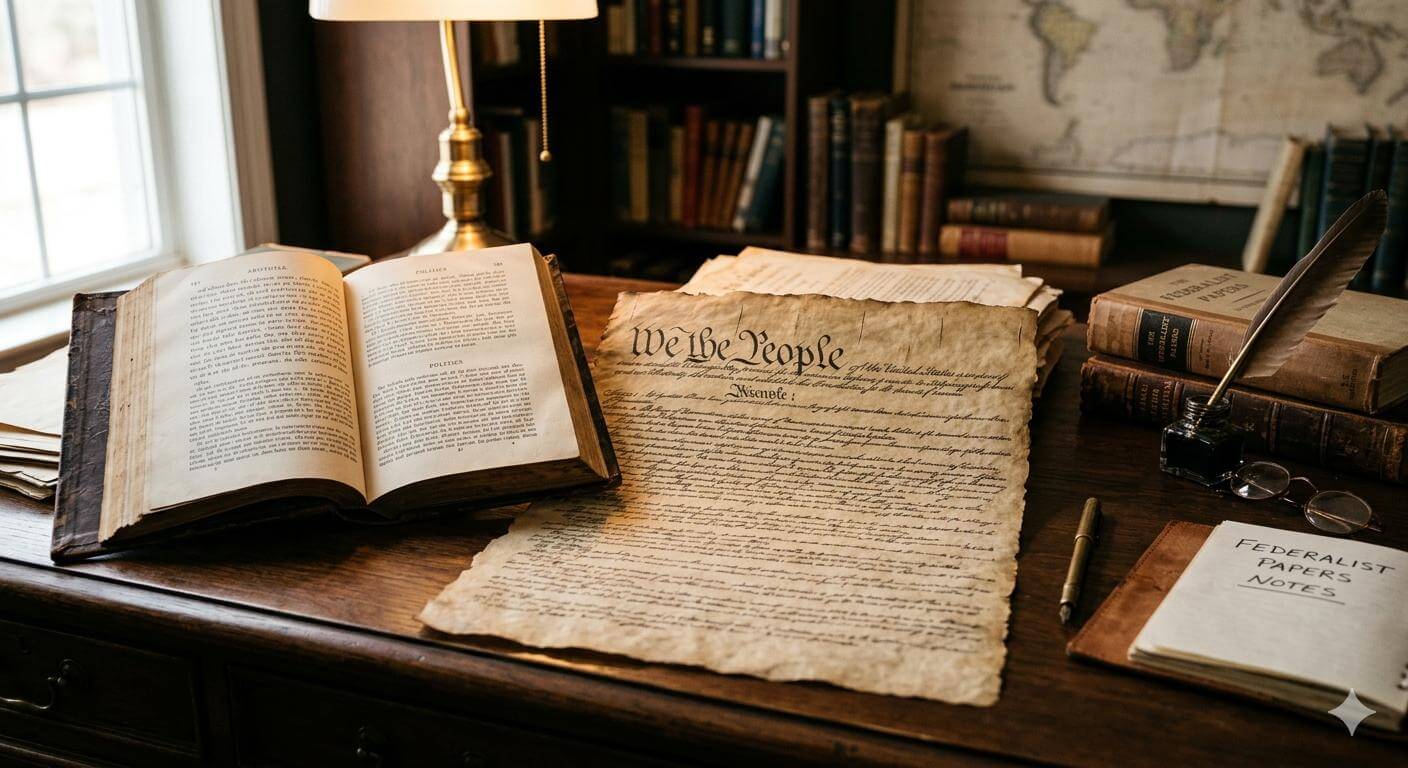
Classical education also treats history cyclically. Students return to the same periods at different stages of their education, each time with greater analytical depth. A student who studied ancient Rome for its narrative facts returns later to analyze its political structures, and eventually to evaluate its political philosophy and connect it to the American constitutional system.
That last point matters more than it is usually recognized. Jefferson, Madison, Hamilton, and Adams were all classically educated.
Their reading of Cicero, Thucydides, and Aristotle was not incidental to their political thinking. The separation of powers, the design of the Senate, and the arguments in the Federalist Papers all have direct roots in the classical tradition.
Students who study that history are not just learning the past. They are understanding the intellectual architecture of the system they will participate in as voters.
Civic Virtue and Civic Knowledge: Why Both Matter
Knowing how a bill becomes a law is necessary for civic participation, but it is not sufficient. A student can pass a civics test without having developed any of the habits of mind that make participation meaningful. This is the distinction between civic knowledge and civic virtue, and classical education takes both seriously.
The ancient Greeks understood that democracy required citizens who could reason carefully, argue fairly, and think beyond short-term self-interest. These are not natural abilities; they are developed through practice.
The Socratic method, discussion-based learning, and rhetorical training all build these capacities deliberately. A student who has regularly defended a position, responded to counterargument, and learned to distinguish a well-supported claim from a weak one is better prepared for civic life than one who has not done any of those things.
Teaching Students How to Think, Not What to Think
One concern parents sometimes raise about civic education is whether it pushes students toward particular political conclusions. Classical education addresses this directly.
Classical civic education is not about telling students what to believe about political questions. It is about developing their capacity to evaluate those questions for themselves.
A student trained in classical history and rhetoric brings a consistent analytical framework to any political claim: What is the evidence? What assumptions does it rest on? What has history shown about similar proposals? What are the strongest counterarguments?
Those questions apply equally to any political claim from any direction. Classical education does not produce students with particular political views. It produces students who are more rigorous in how they think through political questions of any kind, making them harder to manipulate and more capable of genuine independent judgment.
What This Looks Like at VPA Washington
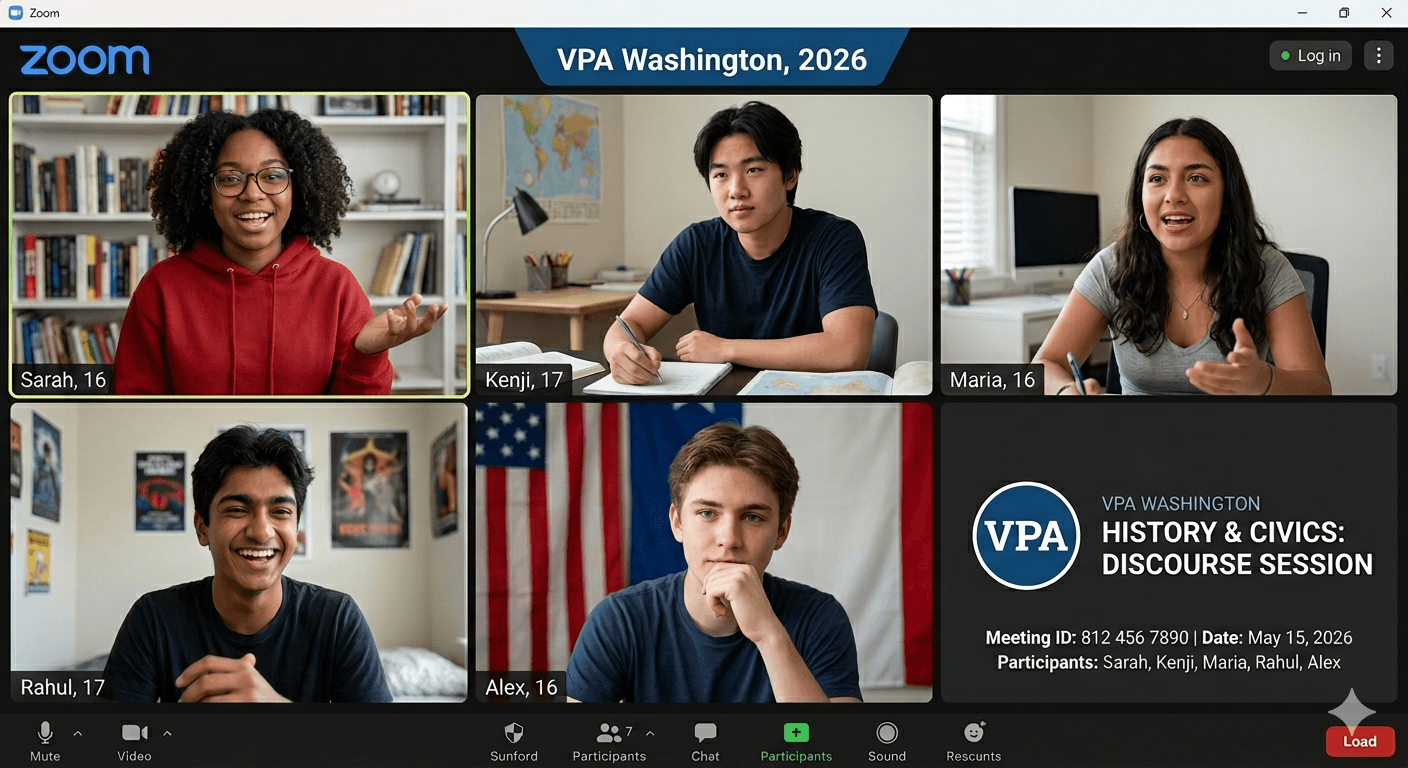
Washington State requires students to complete Washington State History as a graduation requirement. At VPA Washington, that requirement sits within a broader classical approach that gives students the context to understand state history in relation to national and world history.
Live discussion-based sessions give students regular practice in civic discourse: making arguments, responding to counterarguments, and engaging with perspectives different from their own. Washington-certified teachers bring academic rigor to every session, supporting genuine inquiry rather than surface coverage.
At the high school level, VPA Washington’s curriculum includes honors and AP options in US History, World History, and related subjects. These courses are accessible through the school’s AP and honors history options, and prepare students for college-level civic and historical thinking in ways that a standard survey course cannot.
What This Means Beyond the Classroom
As pressure to raise scores in testable subjects has grown, history and civics have been squeezed out of the school day across America. The consequences show up in the Annenberg data, in voter turnout numbers, and in the public’s limited grasp of how its own government works.
A classical approach to history education is not a political program. It is an educational one. Students who understand how democratic systems have worked and failed, and who have practiced the reasoning that civic participation requires, are better equipped for every dimension of adult life as citizens.
|
Ready to Learn More? VPA Washington gives Washington students a curriculum that takes history and civic knowledge seriously. To explore further, visit VPA Washington’s full curriculum or find out about how VPA Washington’s school day works. Our enrollment team is happy to answer any questions your family has. |
Frequently Asked Questions
Why is civic education important in schools?
The 2023 Annenberg Civics Survey found that 17% of American adults cannot name any branch of government. Research also shows that students who complete a genuine civics course are 3 to 6 percentage points more likely to vote after high school. Civic education builds the critical thinking skills needed to evaluate political arguments and participate meaningfully in democratic life.
How does classical education teach history differently?
Classical education treats history as a discipline of inquiry rather than a timeline of dates to memorize. Students work with primary sources and engage directly with the reasoning of historical figures. This approach builds genuine analytical thinking rather than surface familiarity.
Does classical history education take a political stance?
No. The goal is to develop the capacity to evaluate political questions, not reach particular conclusions. The analytical skills built through primary source work and Socratic discussion apply equally to any political claim from any direction.
What civic education does VPA Washington offer?
Washington State History is a graduation requirement at VPA Washington, taught within a classical framework that connects it to national and world history. Live sessions give students regular practice in civic discourse, and high school students can access honors and AP courses in US History and World History.
How does studying ancient history prepare students for modern citizenship?
American democracy was built by people steeped in classical political philosophy. Jefferson, Madison, Hamilton, and Adams drew directly on Athenian democracy and Roman republicanism when designing the American system. Understanding that history means understanding the intellectual foundations of the government, students will one day vote in.
Sources
- Annenberg Public Policy Center. (2023). Many Don’t Know Key Facts About U.S. Constitution, Annenberg Civics Study Finds. https://www.annenbergpublicpolicycenter.org/many-dont-know-key-facts-about-u-s-constitution-annenberg-civics-study-finds/
- Winthrop, R. (2020). The need for civic education in 21st-century schools. Brookings Institution. https://www.brookings.edu/articles/the-need-for-civic-education-in-21st-century-schools/
- Owen, D. (2011). The relationship between civic education and political knowledge. Center for Civic Education. https://www.civiced.org/images/stories/Resources/PapersandSpeeches/Owen_2011.pdf/
- Pew Research Center. (2025). Public Trust in Government: 1958–2025. https://www.pewresearch.org/politics/2025/12/04/public-trust-in-government-1958-2025/