
Some students grasp a lesson quickly, then spend the rest of the class waiting. Others need more time, but the class moves on before the idea fully clicks. Both situations can leave children bored, frustrated, or unsure of themselves.
Mastery-based learning gives students a better path. Instead of moving through lessons only because the calendar says it is time, students move forward after they show real understanding.
In a virtual school setting, this approach works well because teachers can track progress more closely, adjust support, and help each child learn at a pace that fits their readiness.
What Mastery-Based Learning Actually Means
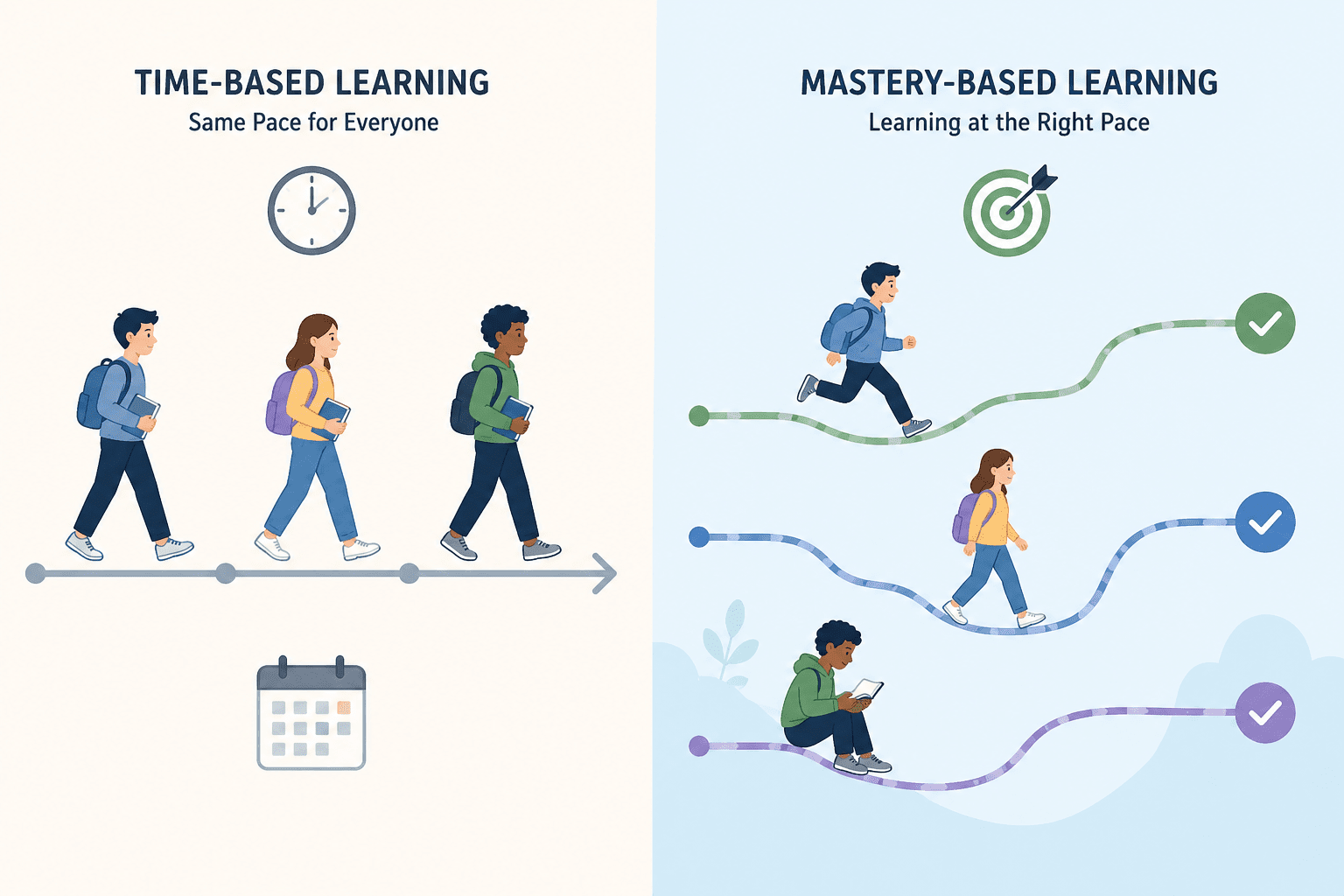
Mastery-based learning (MBL), sometimes called competency-based or proficiency-based learning, treats education as a process of inquiry, not just a collection of facts. Students move forward when they understand a concept, not when time runs out.
In traditional education, progress is often tied to the calendar. For example, a class might move to the next chapter because the week has ended, even if some students are still trying to grasp the current topic. Everyone moves forward together, regardless of readiness.
In a mastery-based system, time is the variable and learning is the constant. Instead of moving forward based on the calendar, students advance only after they can show they truly understand the concept.
In practice, this means:
- Fixed expectations and pace: Every student works toward the same standard, but the time it takes can vary.
- Strong foundations first: Students do not move forward until earlier concepts are clear.
- Active learning: Students work through ideas until they can explain and apply them.
The Problem with One-Size-Fits-All Pacing
In a typical classroom, one teacher sets the pace for a full group of students, and that pace has to work for everyone at once, which means it works perfectly for almost no one.
Students who are still working through a concept get moved on regardless. Those gaps don’t disappear; they compound quietly in the background. By the time a subject gets more demanding, the struggle often traces back to something that was never fully understood years earlier, not a lack of effort or ability.
Students on the other end face a different version of the same problem. They’ve understood the material, they’re ready to go further, but instead they have to wait. Boredom is a predictable result of being asked to sit through lessons you’ve already mastered, and over time, disengagement follows.
None of this is a teacher problem. A single teacher managing a full class on a fixed schedule can’t realistically run 30 different paces at once. That’s a structural constraint, and it’s the reason so many students end up either pushed ahead too soon or held back longer than they need to be.
Why Virtual School Is Built for This
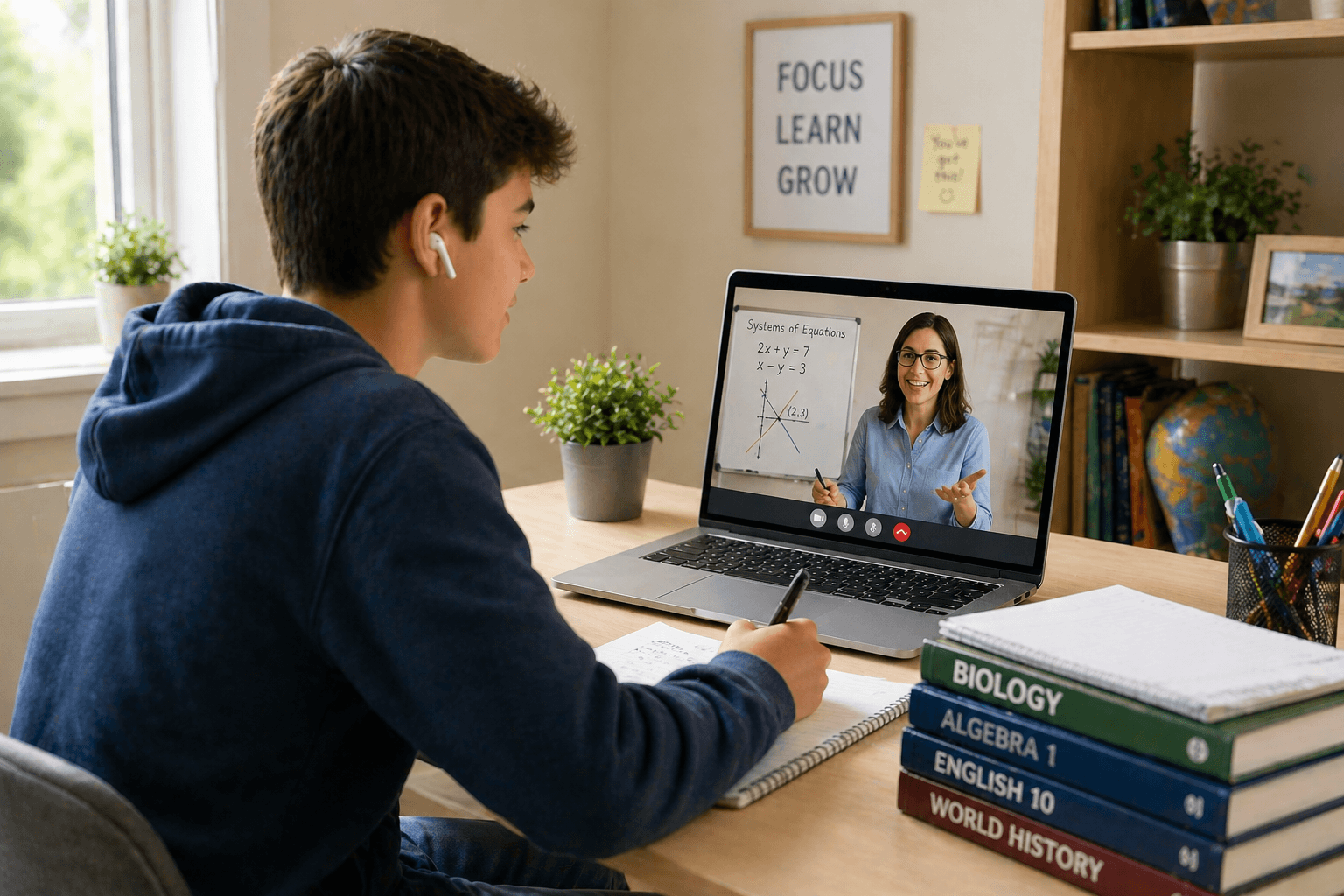
A traditional classroom can’t solve the pacing problem on its own, and that’s not a flaw in the people running it; it’s a flaw in the setup. When one teacher is responsible for 30 students in a fixed time slot, everyone has to move together, and there’s no practical way around it. A virtual school removes that constraint entirely, because the whole model is built differently from the start.
At VPA Washington, how the school day works means students aren’t locked to one teacher’s pace or one class’s schedule. They move through material at the speed their understanding actually supports.
Washington-certified teachers track each student’s progress individually, so they know where each child is, not just where the class average lands. Live sessions, independent assignments, and one-on-one teacher contact create multiple checkpoints throughout a unit, far more visibility than a single end-of-term test ever provides.
The flexibility that comes with virtual school isn’t about doing less. It’s about doing the right work at the right time for each student.
It Goes Both Ways: Faster and Slower
A common assumption is that mastery-based learning means taking longer, but it’s really about taking the right amount of time for each student.
A student who grasps a concept quickly can move ahead faster than they ever could in a traditional class, where everyone has to be ready before anyone advances.
That’s a genuine advantage, not a compromise. On the other side, a student who needs more time to build real understanding gets that time, without the quiet shame of being visibly “behind” in a class moving at someone else’s pace.
VPA Washington’s full curriculum is built around this principle, with the pace set by each student’s actual readiness rather than the school calendar or comparison to peers.
What Assessment Looks Like in a Mastery-Based Model
In a conventional school, assessment is often a single test at the end of a unit, and once it’s done, everyone moves on regardless of the result.
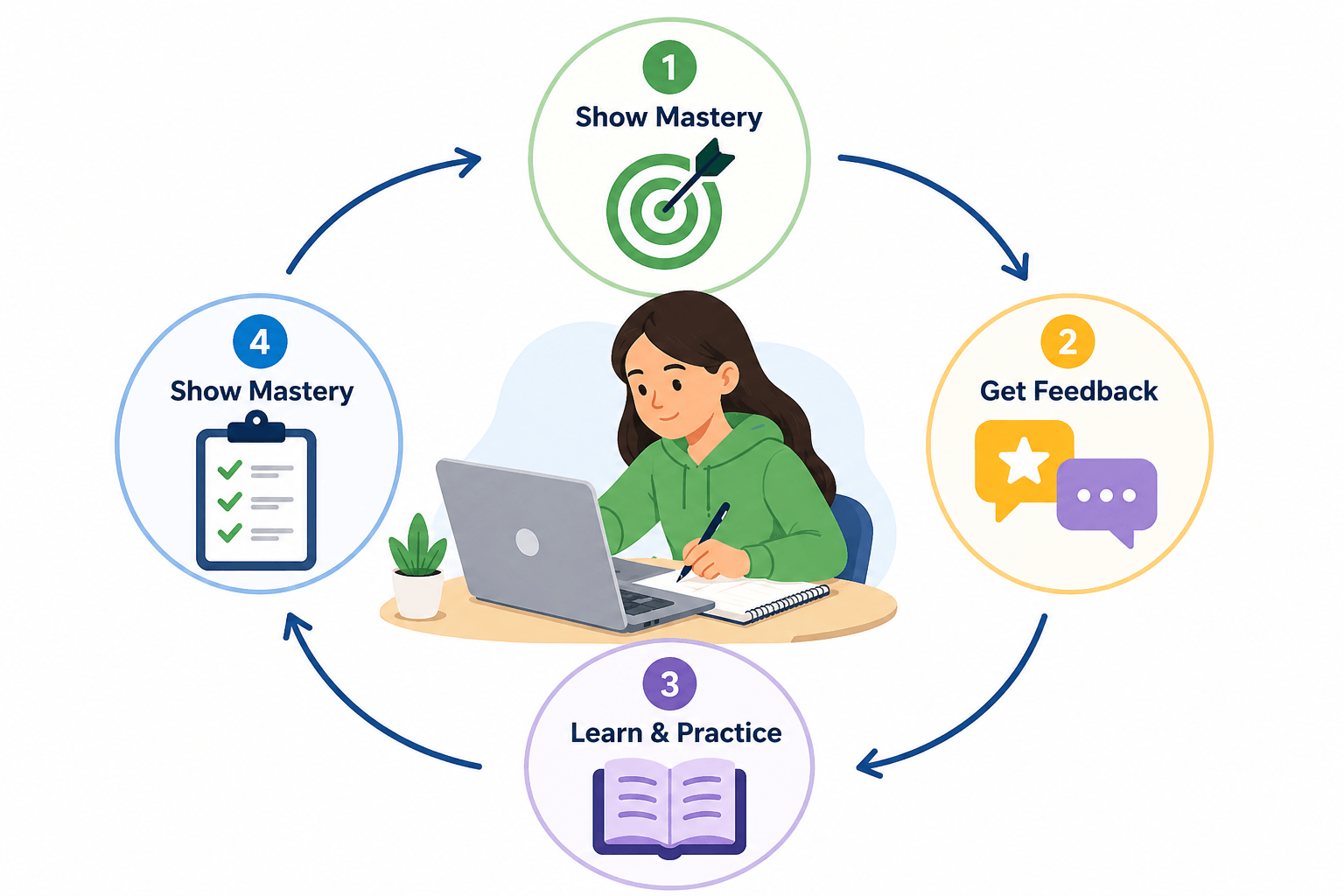
Mastery-based assessment works differently. Understanding is checked as it develops, not just after the fact, so teachers can catch gaps early rather than discovering them at the end of a unit when it’s too late to go back.
At VPA Washington, teachers use short-cycle assessments, ongoing observation, and direct feedback to track where each student stands in real time, giving parents a clear picture of progress at any point in the school year, not just at report card time.
This is where the learning coach role fits naturally. Parents observing their child’s daily work are well-placed to notice when something isn’t clicking and flag it to the teacher early, long before it becomes a bigger problem.
In a conventional classroom, that same parent finds out weeks later through a report card, but at VPA Washington, they know as it’s happening.
Mastery Learning and Washington State Standards
Some parents hear “mastery-based learning” and worry it means stepping away from official academic requirements, but it works entirely within them.
VPA Washington students work toward Washington state academic standards, with the full graduation framework intact. Washington requires 24 credits for high school graduation, covering core subjects alongside Washington State History and a High School and Beyond Plan, and mastery-based progression fits squarely within that structure.
The difference is that students are required to genuinely meet each standard before moving forward, rather than being credited for time spent in a seat.
For high school students, the road to graduation stays fully on track, with AP courses and honors options remaining available throughout. Mastery-based learning supports that path rather than redirecting from it, and students arrive at each next level having actually built the foundation underneath them.
See How VPA Washington Supports Mastery-Based Learning
Mastery-based learning isn’t a new idea, and it isn’t a soft one. It’s a well-researched model built on a straightforward premise: students who genuinely understand what they’ve learned are better equipped for everything that comes next than students who simply got through it.
For parents who have watched a child disengage because school wasn’t keeping pace with them, or struggle quietly because the class moved on before they were ready, VPA Washington’s approach offers something a conventional classroom structurally can’t: a pace that belongs to the student, not the schedule.
If this sounds like what your child needs, enrolling at VPA Washington is a good place to start.
Frequently Asked Questions
What is mastery-based learning?
Mastery-based learning means a student demonstrates genuine understanding before moving on to the next concept or unit. Rather than advancing because the school calendar says so, students progress when they’re actually ready, making it the direct opposite of time-based progression, where the schedule drives everything.
Is mastery-based learning slower than traditional school?
No. Students who grasp material quickly can move ahead faster than a traditional classroom would allow, since they aren’t waiting for the rest of the class. Students who need more time get it without penalty. The pace is personalized in both directions, so the outcome depends on the individual student, not a fixed timeline.
How does VPA Washington support mastery-based learning?
VPA Washington uses individualized learning plans, short-cycle assessments, and Washington-certified teachers who monitor each student’s progress individually rather than tracking a class average. Parents serve as learning coaches, giving them direct, real-time visibility into where their child is at any given point in the school year.
Does mastery-based learning still meet Washington state standards?
Yes. VPA Washington students work toward Washington state academic standards and graduation requirements in full. Mastery-based progression means students genuinely meet each standard before advancing, rather than being credited for seat time alone.
How is progress tracked in a virtual school?
Progress is tracked continuously through short-cycle assessments, teacher observation, and direct feedback, with parents able to see how their child is doing at any point rather than waiting for a report card. That ongoing visibility is one of the clearest advantages of the virtual school model over a conventional classroom.